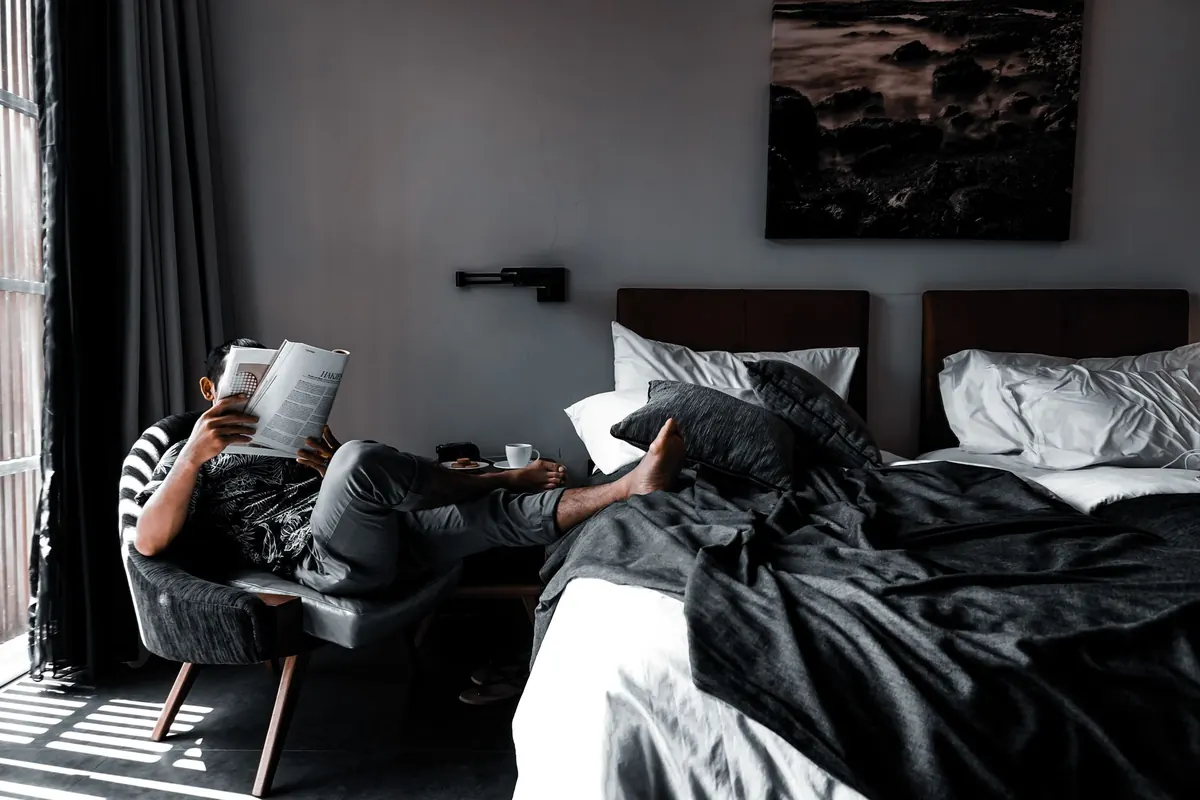
Most reading advice starts in the wrong place. It asks whether you prefer crime or romance, literary fiction or memoir, as though taste were a fixed address you find once and then stay at. In practice, the book that works on a Sunday morning with coffee is rarely the book that works at eleven at night after a difficult day. Mood, attention, and how much feeling you have to spare matter more than the label on the spine. This is a guide for readers who keep abandoning books at page sixty and suspect — correctly — that it might not be the book's fault.
Start With Your Energy, Not the Shelf Label
Genre tells you what a book is about. It says almost nothing about what reading it will feel like at the end of a working day. Two novels can both be described as literary fiction and ask completely different things of you: one has forty short chapters and a single narrator, the other has five timelines and a family tree on the first page.
A more useful way to sort books is along three lines: how much attention they need, how much emotion they demand, and how much momentum they supply. Attention is the obvious one — a dense 600-page novel is a different commitment from a slim essay collection. Emotional bandwidth is the one readers forget. Some weeks you can read about grief and addiction; other weeks you need a book where the worst thing that happens is a cancelled wedding. Momentum is what keeps you turning pages: a plot with questions in it, a voice you want to keep hearing. Get those three roughly right and the genre takes care of itself.
Four Questions to Ask Before You Pick a Book Up
Before choosing your next read, spend thirty seconds on these. The answers change week to week, which is exactly why a fixed reading list rarely works.
- How much time do I actually have? Be honest. Twenty minutes on a commute is a different reading life from two hours on a Sunday. If the answer is "ten minutes a night," short chapters and clean scenes will serve you better than long, winding paragraphs.
- How much feeling do I have to spare? If work or family has taken everything, pick something that entertains without asking you to hold someone else's pain. Save the harrowing memoir for a steadier month.
- Do I want to go somewhere else, or think about my own life? Both are legitimate. Just don't expect a novel about divorce to be a holiday, or a thriller to give you insight.
- What do I want to feel when I close it? Comforted, unsettled, energised, less alone. Naming the feeling narrows the shelf fast.
Reading Lists by Mood
These are starting points, not rules. Use them to narrow the search, then follow your own curiosity.
When you're running on empty
You want low stakes, familiar rhythms, and a voice that asks nothing of you. This is the moment for a series you already know, a comfort reread, a cosy mystery where the violence happens off the page, or the essayist you trust to be kind. Rereading is underrated: your brain already knows the shape of the plot, so you can read for pleasure rather than suspense. Keep two or three of these on a shelf and stop treating them as a guilty habit. They are what gets you back to reading after a fallow stretch.
When you're anxious or scattered
A scattered mind usually wants structure. Look for a single narrator, a clear chronology, short chapters, and a story that resolves. Avoid sprawling family sagas with four generations and a map. Nature writing, travel diaries and gentle non-fiction also work well here, because the stakes are low and the sentences do the work of slowing you down. If your mind is jumping, a book of very short stories — two or three pages each — can be easier to enter than a novel you have to hold in your head for a week.
When you want to be swallowed whole
Some moods call for a long, immersive novel you can disappear into for hours. These books are wonderful and badly suited to a busy Tuesday. Save them for a weekend, a train journey, a holiday, or a stretch when nobody needs you at seven in the morning. The tell is simple: if you keep checking the page count, you're reading it at the wrong time, not the wrong book.
When you're restless and curious
Restlessness responds to variety. Keep a collection of essays, poetry, or short stories by the bed and read three pages at a time. Nobody finishes an essay collection in order, and nobody needs to. This is also the mood for browsing: a bookshop, a library shelf, a friend's recommendations. Curiosity is a fine reason to start a book and a fine reason to abandon it.
Match the Book to Your Attention Span
The single most practical thing you can check before buying a book is chapter length. Open it in the shop and look at three random pages. Short chapters with white space at the bottom are built for interrupted reading. Long unbroken paragraphs are built for a chair, a lamp, and a quiet hour.
Consider your format too. A paperback lives in a bag; an audiobook turns a walk into reading time; a book on your phone works for queues and waiting rooms. Match the format to the gap in your day, not to your aspirations. Someone with a forty-minute commute and no evening energy reads more audiobooks than hardbacks, and there is no moral difference between them. Reading two books at once is also allowed — one for the commute, one for the sofa — as long as you don't expect both to move at the same speed.
Test a Book Before You Commit a Week to It
You wouldn't buy shoes without trying them on. Books deserve the same courtesy.
- Read the first twenty pages. That's usually enough to know whether the voice holds you.
- Read a page from the middle. It tells you what the book is like once the setup is over.
- Read a paragraph aloud. Clunky prose is easier to hear than to see.
- Set a quitting point in advance. Fifty pages, or a hundred if you're unsure. Reaching it and still dreading the book is permission to stop.
- Note why you stopped. Wrong mood, wrong time, or genuinely not for you — the distinction matters when you try again.
A Practical Close: Keep a Three-Line Reading Log
After each book, write three lines: what you read, how you felt while reading it, and whether you'd pick up something similar again. Two minutes, no app required — a notebook by the bed is enough. Within a couple of months you'll have a personal map of what actually works, as opposed to what you think you should enjoy.
That log will also teach you the most useful lesson in all of this: a book you abandon isn't a failure, it's information. Most readers who describe themselves as slow, or out of practice, are simply handing themselves the wrong book for the week they're having. Change the book, not the reader.
Photo: Sergey Torbik / Pexels