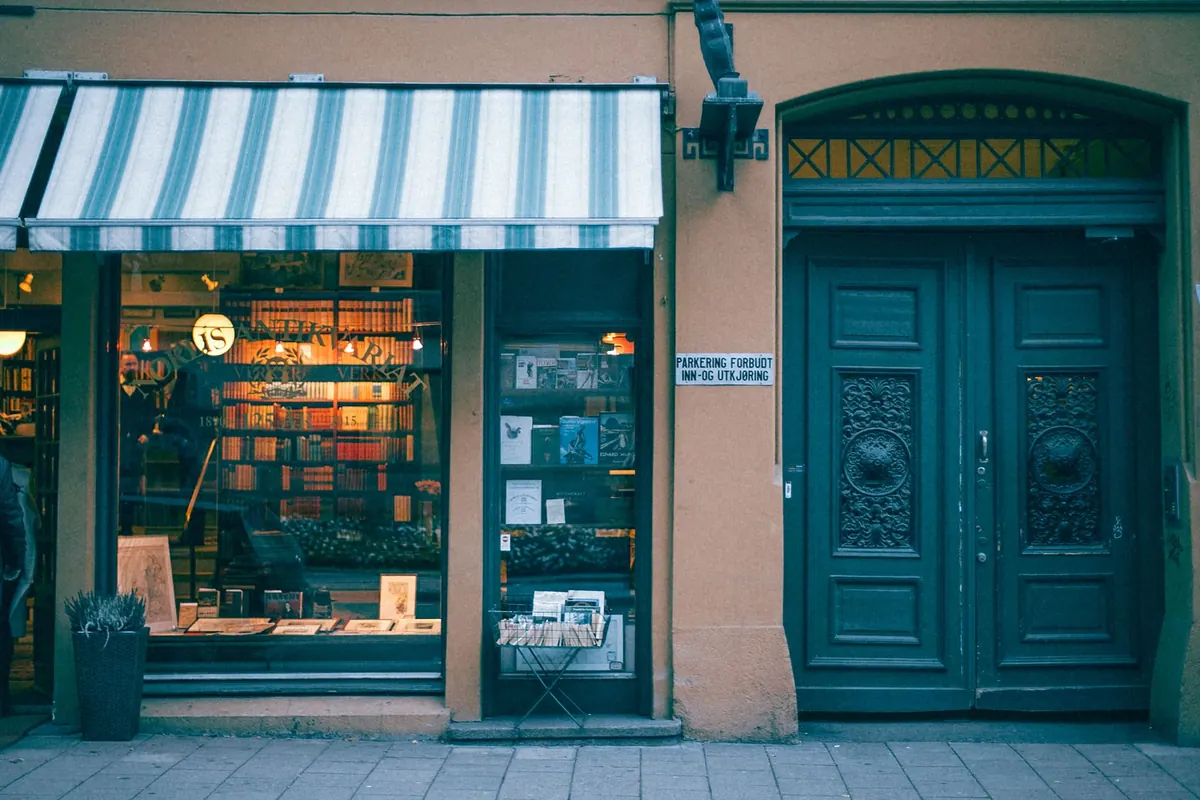
A bookshop is a good excuse for a trip. Not the only one, and not even the best one, but a reliable one: it gives you a neighbourhood to walk to, a reason to push past the obvious square, and something to carry home that weighs more than a magnet. Italy rewards this habit. The country's best shops are rarely the biggest, and they are almost never on the route between the station and the cathedral. They sit in a former convent, behind a newsstand, on a canal edge where the water comes in twice a year.
What follows is not a ranking. It is a set of places worth building a few days around, plus the small skills that turn a five-minute visit into an hour you don't regret.
Read the Shop Before You Read the Shelves
Italian bookshop vocabulary does most of the work for you. A libreria is a bookshop; a library is a biblioteca, and asking for the wrong one will send you politely across town. Look for these words on the door or the window:
- Novità — new releases, usually the table by the entrance. Staff choices, not publisher money, if the shop is any good.
- Varia — general stock: fiction, essays, whatever doesn't fit elsewhere.
- Antiquaria — antiquarian: rare, old, expensive, often beautiful. Not the same as libri usati, which just means second-hand.
- Remainder — cut-price overstock, often art books at a third of the cover price.
- Collana — a publisher's series. Italians buy by series the way other readers buy by author.
Two habits will endear you to any bookseller. Greet them when you walk in — a quiet buongiorno is enough — and don't reshelve. Pick up, look, then leave the book on the table or hand it over. In a small shop with 4,000 titles and one person working, a misplaced spine is a real cost.
Venice: Where the Water Sets the Rules
Libreria Acqua Alta, in Calle Lunga Santa Maria Formosa, is the one everybody photographs: books in bathtubs, books in a gondola, a courtyard staircase built from water-damaged encyclopaedias. It is tiny, it is packed by mid-morning, and it is closer to theatre than retail. Go early, buy a book, and treat the queue as part of the price.
The better browsing is elsewhere. In Dorsoduro, Libreria MarcoPolo runs readings and has a decent English-language shelf without feeling like an airport shop. Near the Accademia, Libreria Toletta is the old-fashioned, well-lit, properly stocked kind of shop where a bookseller will spend ten minutes finding the right Italian translation of a poet you half remember. Venice has lost a lot of shops to rent and water; a Dorsoduro–San Polo loop on foot will take an afternoon and give you three good doors.
Milan and Turin: Art Books, Politics, and the Antiquarian Trail
In Milan, Libreria Bocca has been selling art books since the eighteenth century and now sits inside the Galleria Vittorio Emanuele II, a few metres from the noise of the arcade. It is small, it is serious, and it is the rare case where a shop in a tourist landmark is still a shop. North of the centre, the independent scene is livelier: Libreria Verso and Libreria Antigone both programme events, stock small presses, and stay open into the evening.
Turin is the country's most bookish large city, partly because the Salone Internazionale del Libro lands there each May. Libreria Luxemburg, near the university, is a good place to see what Italian readers are actually arguing about. Libreria Trebisonda is smaller and sharper. And if your taste runs to calfskin and foxing, the antiquarian dealers around Via Accademia Albertina — Pregliasco among them — will let you handle a 1620 atlas if you ask nicely.
Trieste, Bologna, Florence: The Specialist Shelf
Trieste has a bookshop with a poet's name on it. Umberto Saba ran an antiquarian shop in Via San Nicolò, and the business still trades under his name. It is a working shop, not a museum: expect catalogues, ladders, and a bookseller who knows what's in the back room. Ask before photographing anything.
Bologna suits readers who like their bookshops argumentative. Modo Infoshop, near Via Mascarella, mixes zines, cinema, and political writing; Libreria delle Donne has been a feminist institution for decades and stocks a shelf of Italian writing you won't find elsewhere. In Florence, Libreria Alberto Casini on the Lungarno is the place for fine bindings and old prints, while Libreria Brac turns browsing into dinner — books upstairs, a small kitchen downstairs.
Rome and the South: Cloisters, Late Hours, Second-Hand
Rome rewards walking between shops rather than taking taxis. Libreria Tuba, in Monti, is open late, crowded with students, and good on contemporary Italian fiction. Near Piazza Navona, Altroquando pairs second-hand stock with a bar and a long evening. In Trastevere, Open Door is the city's dependable English-language used shop — the right stop if you've finished your holiday reading on day three.
Naples keeps bookselling in the streets off Spaccanapoli, where Libreria Dante & Descartes spreads through a historic courtyard and stays open when other shops have shuttered. In Palermo, Libreria Modusvivendi is the island's best-known independent and a reliable source of Sicilian writing in translation. And in Bari, the Laterza bookshop — run by the family that has published Italian philosophy for over a century — is worth the detour even if you only buy a paperback for the train.
How to Browse Like a Reader, Not a Tourist
Go in with a question, not a shopping list. A bookshop can answer a question. It can only confirm a list.
- Start at the tables, not the walls. Tables are staff picks and new arrivals. Walls are backlist. You can buy the backlist at home.
- Ask one specific question. "What Italian novel would you give someone who loved Elena Ferrante but wants something less famous?" works. "What do you recommend?" rarely does.
- Buy the local edition. Italian paperbacks (tascabili) are cheap, well designed, and often carry afterwords you won't get in translation.
- Note the publisher, not just the title. Learn a few imprints and you can judge a shelf at a glance: Adelphi for its grey-and-orange classics, Einaudi for literary fiction, Minimum Fax for American writing, Iperborea for Nordic literature in translation, Nottetempo for short sharp essays.
- Photograph the cover, not the shop. One photo of a book you almost bought is a better souvenir than forty of shelves.
- Buy something small. Even a postcard. Shops that survive on browsing alone don't survive.
Practical Notes Before You Go
Hours are the main obstacle. Many independent shops close for two or three hours at lunch, often roughly 13:00 to 16:00, and a number shut on Sunday and Monday morning. Check the shop's own social media rather than a mapping app, which is frequently wrong about Italian retail. In August, especially around Ferragosto on 15 August, small shops can close for a week or more; plan city visits for September to June if bookshops are the point.
Carry some cash for antiquarian and second-hand dealers, and check what your airline allows before you buy three hardbacks. Most shops will gift-wrap, few will ship abroad, and larger antiquarians can arrange couriers if you ask. Keep an eye on windows and doorways for presentazioni — book launches, usually free, usually with a glass of something afterwards, and the fastest way to spend an evening among locals rather than visitors. If you want to time a trip around books, Turin's fair in May, Rome's Più Libri Più Liberi in December, and the spring Book Pride circuit are the dates worth checking.
Finally, plan by neighbourhood, not by map pins. Two good shops a ten-minute walk apart, with a coffee in between, will teach you more about Italian reading life than a day of crossings
Photo: Maria Orlova / Pexels